This is a story about five people who don’t know each other. Each has her own problem, her own week and her own way of telling whether things went well. For much of what follows they move separately. At some point, their paths cross.
Cast · in order of appearance
- AnaJust appointed coordinator of a team of six.
- CamilaRuns training for a network of local governments.
- InésAn expert. She spent four months writing a course.
- ElenaDecides whether funding for a training programme is renewed.
- The meetingA community meeting in a rural municipality, on a Thursday afternoon.
Ana · Monday, 7:40 a.m.
On Friday she got the news: from today she coordinates a team of six. Two weeks ago she was one of them. Ana is good with data, one of the best in her office. What she has never done is delegate, give feedback to someone who was her peer until yesterday, or run a meeting where not everyone agrees. And in three weeks she has to present results to the committee.
She opens her institution’s training platform. It offers her Leadership for new managers: forty hours, twelve modules, a certificate at the end. Ana has, being generous, twenty-five minutes a day. She closes the tab.
Camila · Monday, 10:15 a.m.
The quarterly report came out well: eighty-seven per cent completion, four point six out of five for satisfaction, twelve hundred people certified. Her director reads it in silence and asks the one question Camila has no chart for: and what changed?
Inés · Tuesday, 9:00 p.m.
Inés wrote the network’s facilitation course. Four months, eight modules, a piece of work she is proud of. Tonight she checks the statistics: people drop out in module two. And in the forum, the same question comes up every week in different words: what do I do when the same people always do the talking in a meeting? The answer is in module five. Almost nobody gets to module five.
Elena · Wednesday, 8:30 a.m.
Elena works for the funder of the training programme. In two weeks she has to recommend whether it is renewed. On her desk is a folder with twelve hundred certificates. A certificate says someone was there. It doesn’t say what they did afterwards.
The meeting · Thursday, 4:00 p.m.
In the community hall of a rural municipality, the participation meeting gets under way. The same three people as always do the talking. A woman at the back raises her hand twice, and both times someone keeps talking. By six, half the room has gone. Nobody in that room knows that what just happened has anything to do with a course.
01 — The warehouseWhat the LMS got right, and what it became
Learning management systems, LMSs, solved an enormous problem. Before them, training a thousand people meant rooms, photocopies, travel allowances and paper attendance sheets. With them, an organisation could publish a course once and take it anywhere, know who had taken it, certify, meet mandatory training requirements and do it all at scale. Moodle, for example, has been holding up training for universities, governments and organisations around the world for more than twenty years. That is no small thing.
But an LMS is built around one unit: the course. And around one question: did they finish it? Over the years, most became what their design invited them to be: a warehouse. Shelves of courses arranged by catalogue, run by someone who decides what is on offer, measured by how many get completed.
The problem isn’t the warehouse. It’s that people don’t learn by shopping in a warehouse. Ana doesn’t need forty hours of leadership. She needs to know what to do on Tuesday, when she has to ask a former colleague to redo a report. Research on massive open online courses shows it starkly: in the big open programmes, the share of enrolled people who finish has hovered around three per cent. And on the memory side, Ebbinghaus showed more than a century ago what anyone suspects: what isn’t used is forgotten within days.
People aren’t looking for a course. They’re looking to solve something. The course is, sometimes, the longest road to that answer.
02 — The ideaWhat an LXP is
A learning experience platform, an LXP, changes the starting point. It begins not with the catalogue but with the person: what they know, what they need to solve, how much time they have and what they want to achieve. From there it suggests, supports and measures. The term caught on around 2017, through analysts such as Josh Bersin, to describe a generation of platforms that wanted to look less like an archive and more like a conversation.
| LMS · the warehouse | LXP · the workshop | |
|---|---|---|
| Starts with | The catalogue | The person and their goal |
| Unit | The course | The step that solves something |
| Who decides the path | The administrator | The learner, with a guide that explains why |
| What gets measured | Completion and satisfaction | Clarity, application, goals achieved |
| Content | In-house and closed | In-house, aggregated and co-created |
| With whom | Alone | With mentors, peers and community |
| Proof of learning | Certificate | Evidence of what was done with it |
The real difference is in the last row. The LMS certifies that someone went through some content. A well-made LXP should be able to show what that person did with what they learned.
03 — Why nowFour things that changed
- Personalising stopped being expensive. Adapting a path to each person, explaining a recommendation or talking through a plan required, until recently, one human tutor per person. Artificial intelligence has brought that cost down radically. What was a luxury of executive programmes can reach a field technician.
- Organisations started talking in skills, not job titles. Competency frameworks stopped being HR documents and became the language for deciding who does what.
- Nobody has forty hours. Time for learning has broken into stretches of fifteen or twenty-five minutes. A platform that can’t work in those stretches is no use to almost anyone.
- Counting is no longer enough for funders. Cooperation agencies, governments and companies increasingly ask for evidence of change, not of attendance. The certificate has lost its value as proof.
04 — The trapThe Netflix of courses
It’s worth being honest here, because many platforms that call themselves LXPs fell into a trap. They took the logic of video platforms: recommendations, carousels, “because you watched this, you might like that”. The result was the same warehouse with nicer shelves. More content, better presented, just as far from Ana’s Tuesday.
Recommending content is not supporting someone’s learning. Personalising a catalogue is not personalising a path. The question that matters isn’t what else could you watch? but what do you need to be able to do, by when, and what are you missing?
The shift isn’t from one catalogue to a better catalogue. It’s from content to action.
05 — No funeralsThe LMS isn’t dead
It would be easy, and false, to say that LMSs have expired. Mandatory training, certification, regulatory compliance and long, structured programmes still need a solid, auditable, stable backbone. What changes is where the LMS sits: it stops being the experience and becomes the infrastructure the experience is built on.
This isn’t a theoretical position. What I show in part two is built exactly that way: on Moodle. The warehouse is still there, with its courses, its grades and its certificates. On top of it there is something else.
06 — The goalWhat should change for each of them
If an LXP works, it should show in all five stories, not only the learner’s.
- The learner knows what she is strong at and what she lacks, gets a path that fits her time and understands why it is being suggested. She learns at her own pace, but not blindly, and ends up with evidence of what she did, not just a certificate of attendance.
- Whoever runs the training stops reporting completion and starts seeing gaps, progress against a baseline and where people are getting lost.
- Whoever creates the content knows exactly which step isn’t understood and what real questions people have, and can improve her work with data instead of hunches.
- Whoever funds it receives aggregated, anonymous evidence of change: goals achieved, applications at work, growth in competencies. She can decide with something more than a folder of certificates.
- Society, which is the reason for almost all public and cooperation-funded training, gets public servants who do their jobs better. That is the only thing that, in the end, justifies the rest.
It’s called vetalearn. In Spanish, a veta is the grain that runs through a stone or a piece of wood and gives it its character. It is also the seam worth following. I liked the idea of a platform that finds each person’s grain.
It’s a personal project, under construction, in alpha. It runs on Moodle and adds a full experience layer on top: diagnostic, paths, a guide, mentoring, an evidence portfolio, tools for content creators and an impact dashboard. Everything that follows is real screenshots from a test environment with demo data.
Let’s go back to our five stories.
Ana · Monday, 8:10 a.m.
This time, instead of a catalogue, the platform asks her for eight minutes.
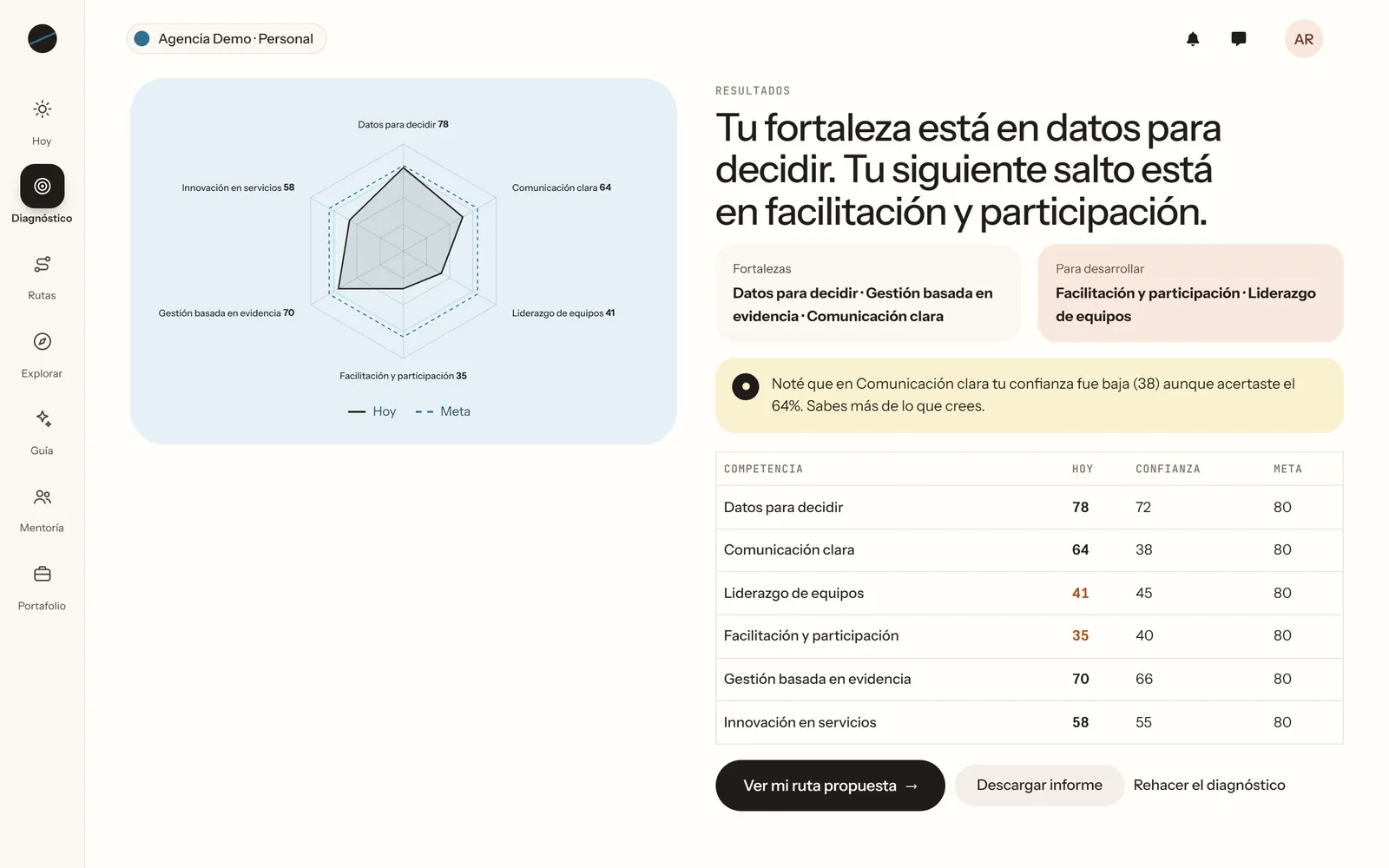
The diagnostic doesn’t ask her for definitions. It puts situations from her work in front of her and asks her, separately, how confident she is in each answer. The result surprises her: she is strong in data, and her biggest gap is in facilitation and participation. And there is something else: in communication she got sixty-four per cent right, but her confidence was thirty-eight.
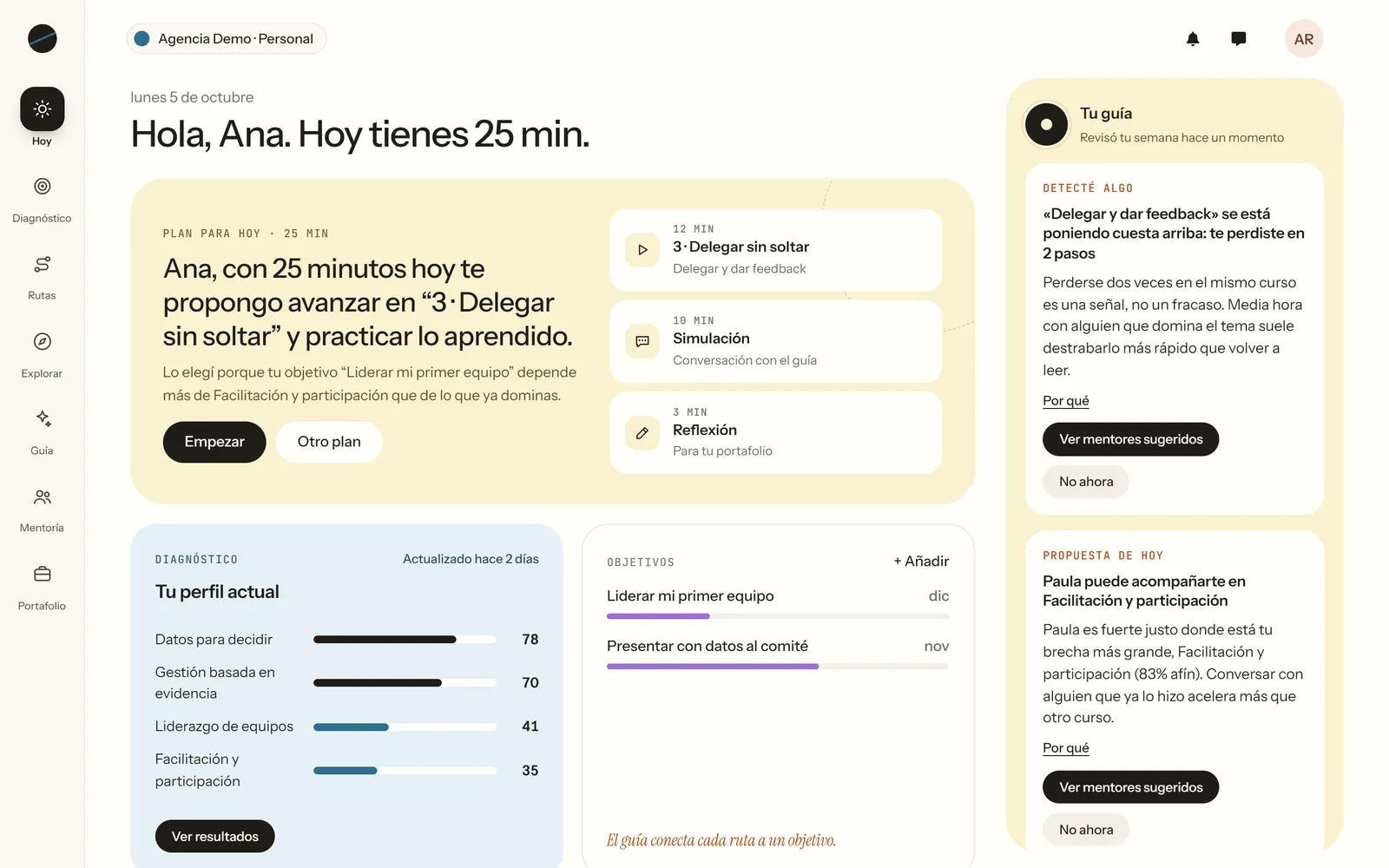
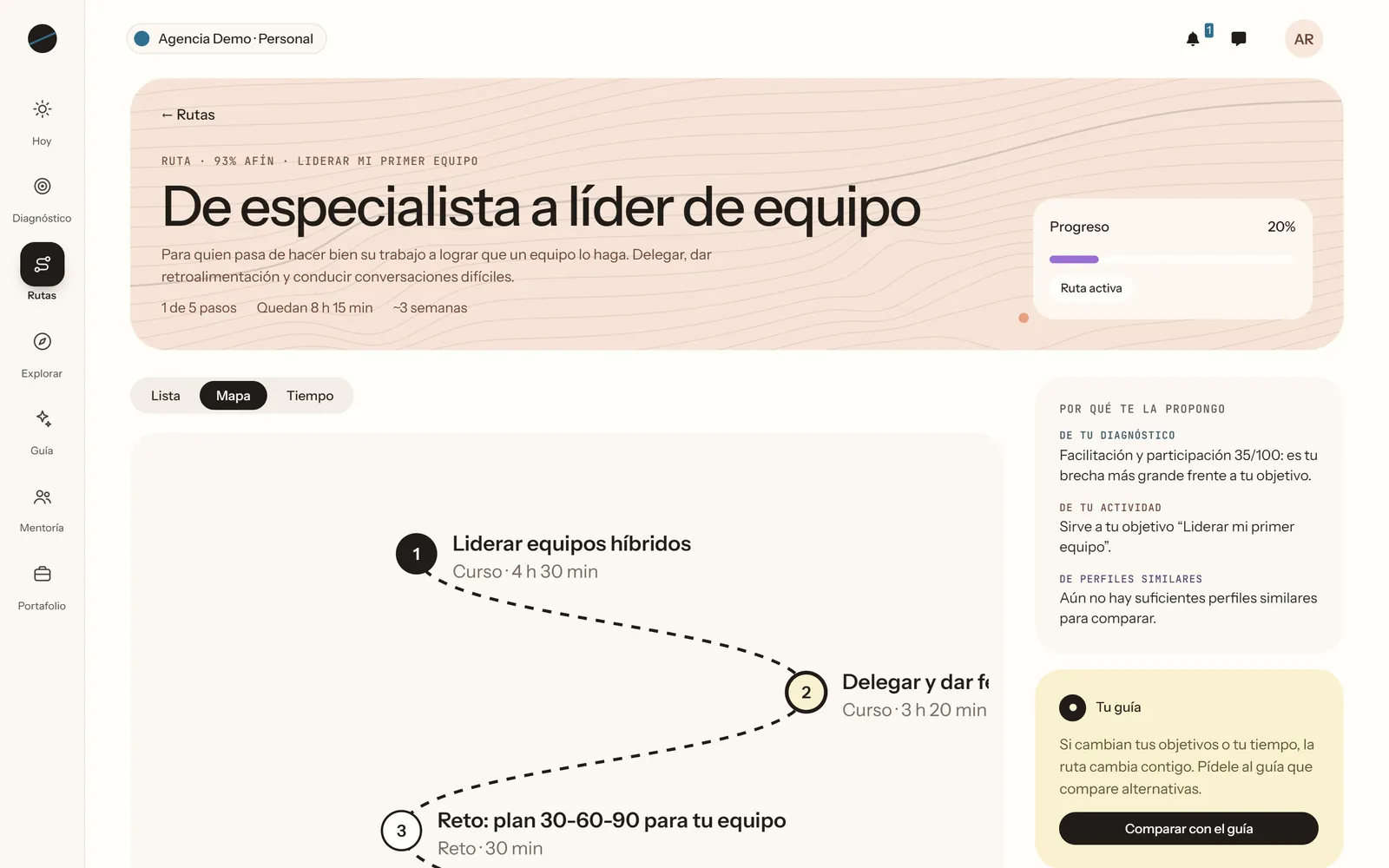
The next day the platform doesn’t show her forty hours. It shows her what fits in twenty-five minutes, and why.
07 — The crossing“I’m lost”
Ana · Wednesday, 7:55 a.m.
Third lesson: delegating without letting go. At the end of each step, the platform asks something almost no platform asks: how clear was that? Ana hesitates. Then, honestly, she ticks I’m lost.
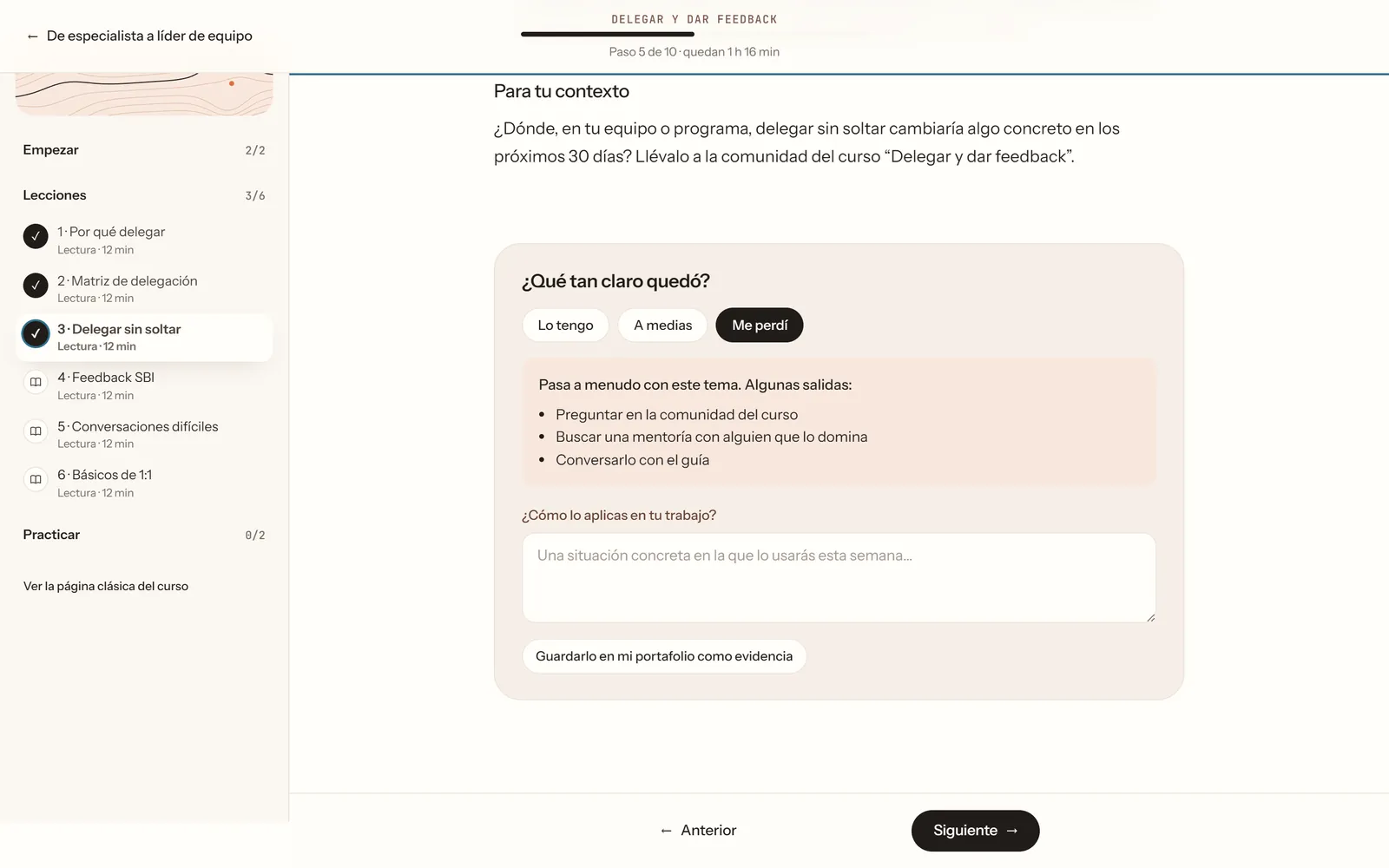
In an LMS, that moment doesn’t exist. Ana would have carried on, or dropped out quietly, as almost everyone does. Here, that click does three things at once. And it is in that click that the stories start to touch.
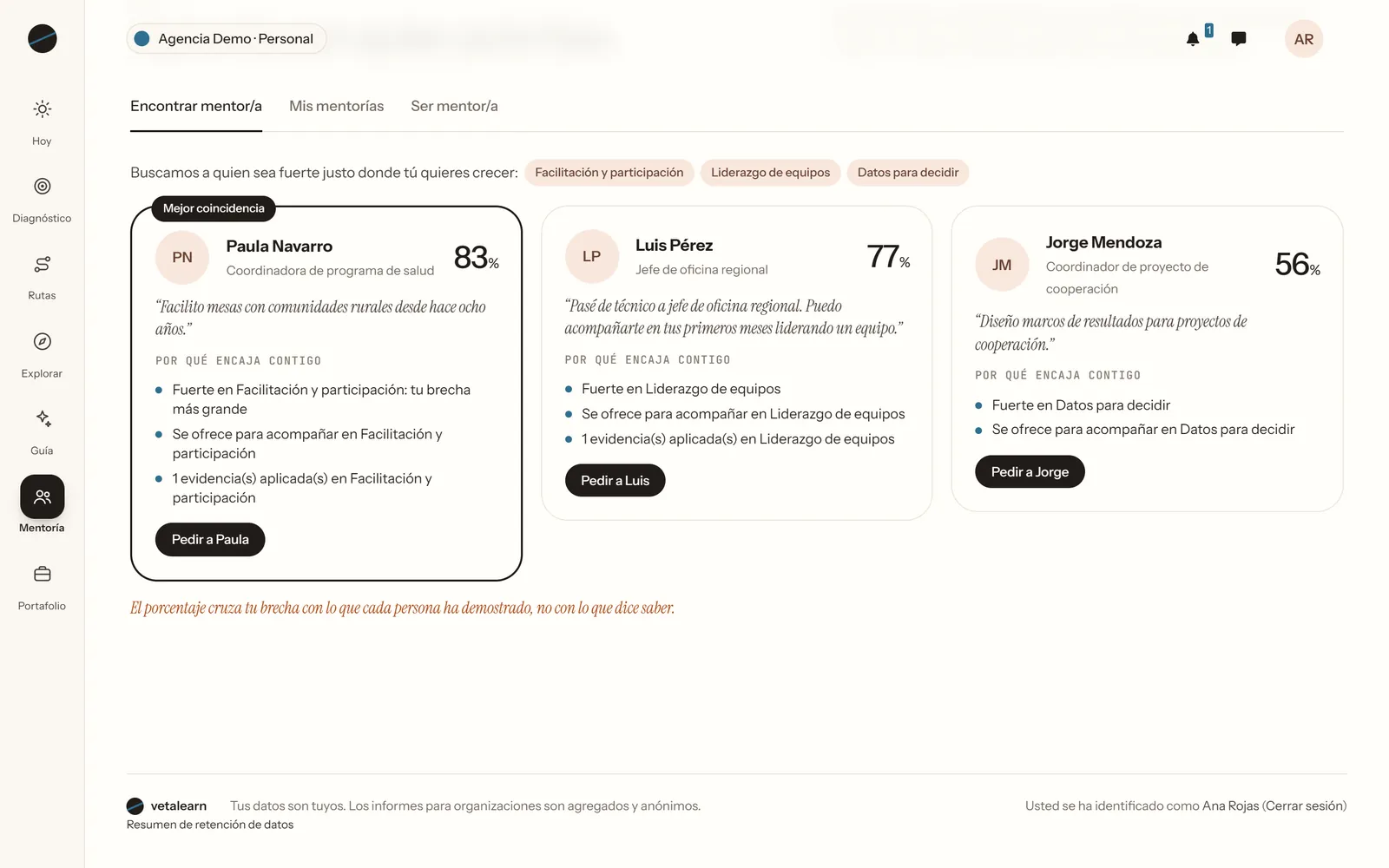
For Ana, the guide notices. Getting lost twice in the same course is a signal, not a failure. It suggests something else: half an hour with someone who knows the subject well. Her name is Paula; she coordinates a health programme and has spent eight years facilitating meetings with rural communities. The platform explains why she is a good fit: she is strong exactly where Ana is weak, and she has shown it with evidence, not just claimed it.
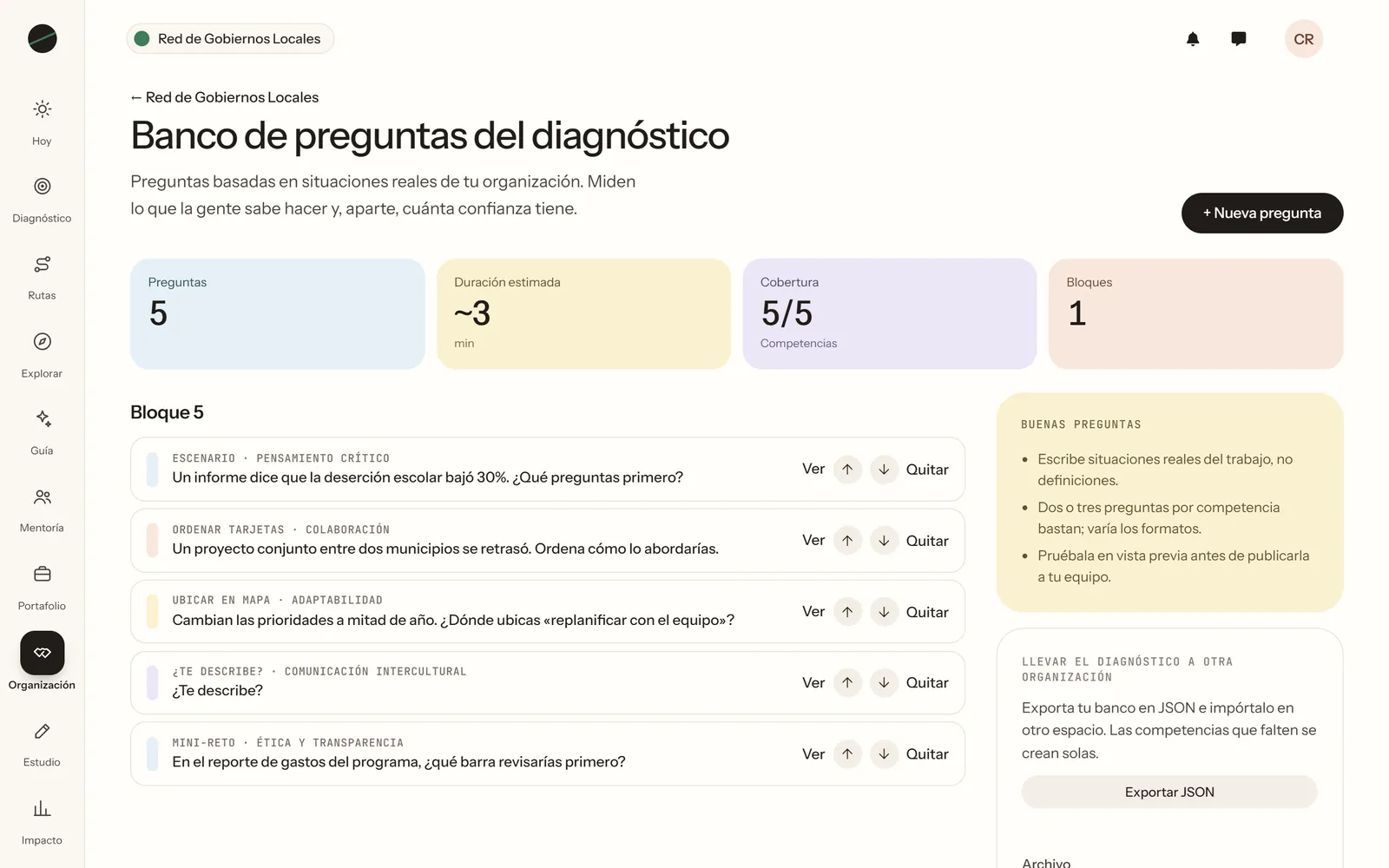
For Inés, that “I’m lost” stops being invisible. Added anonymously to everyone else’s, it tells her exactly which step isn’t understood. She no longer has to guess why people drop out in module two. And the diagnostic’s question bank asks her for what she already knew how to do: write real situations, not definitions.
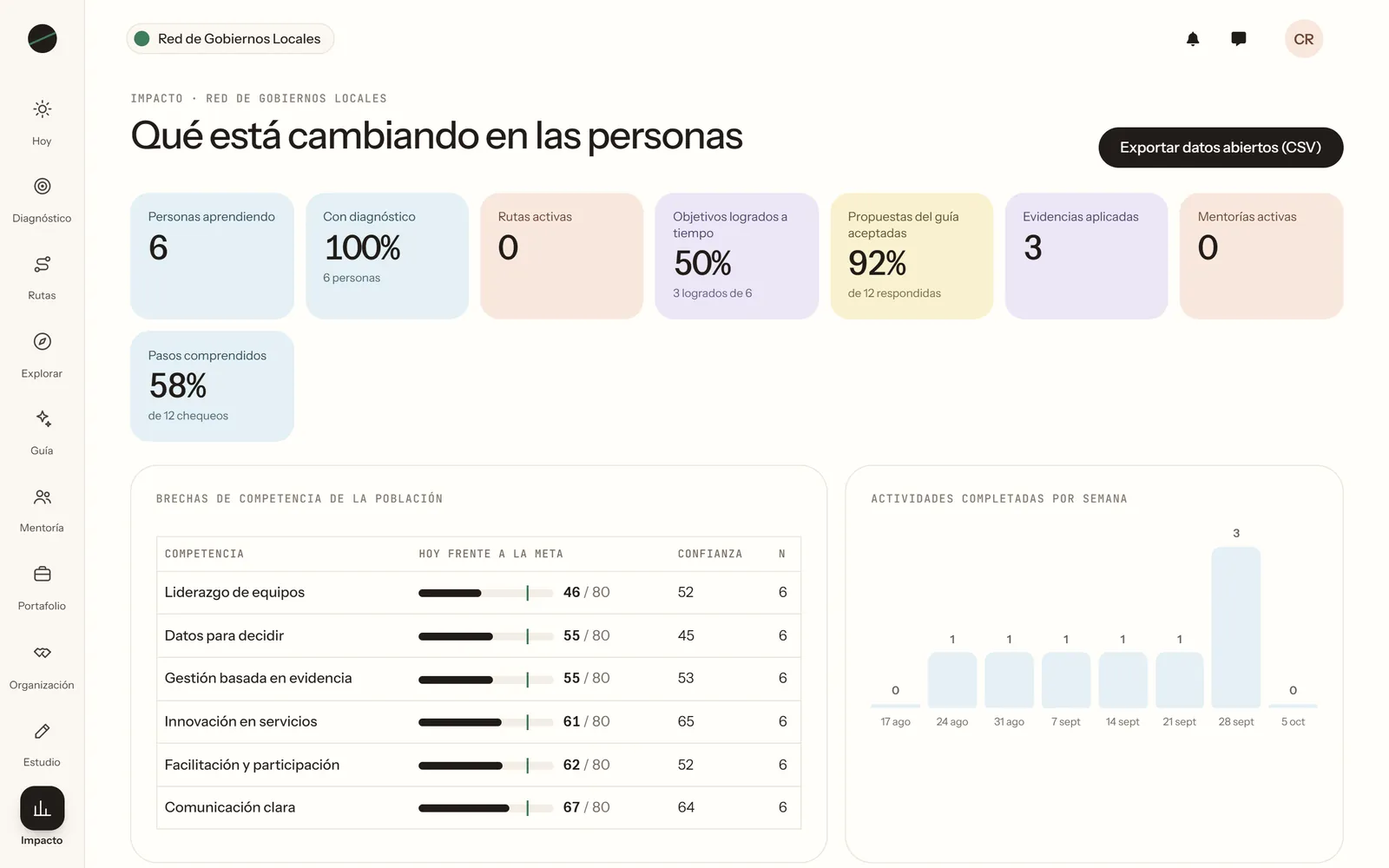
For Camila, the dashboard is no longer called “completion”. It’s called what is changing in people. She sees competency gaps against the target, goals achieved on time, applied evidence and the share of steps people actually understand. Now she has something to tell her director.
08 — The guideAn intelligence that explains its decisions
Ana · Friday, 7:30 a.m.
Ana asks the guide what happens if she puts leadership first and leaves data for later. The guide gives her no magic answer: it sets two routes side by side, with estimated dates for each goal, tells her which one it recommends and why, where that recommendation comes from and how confident it is. Medium confidence. I’ll review it again in two weeks.
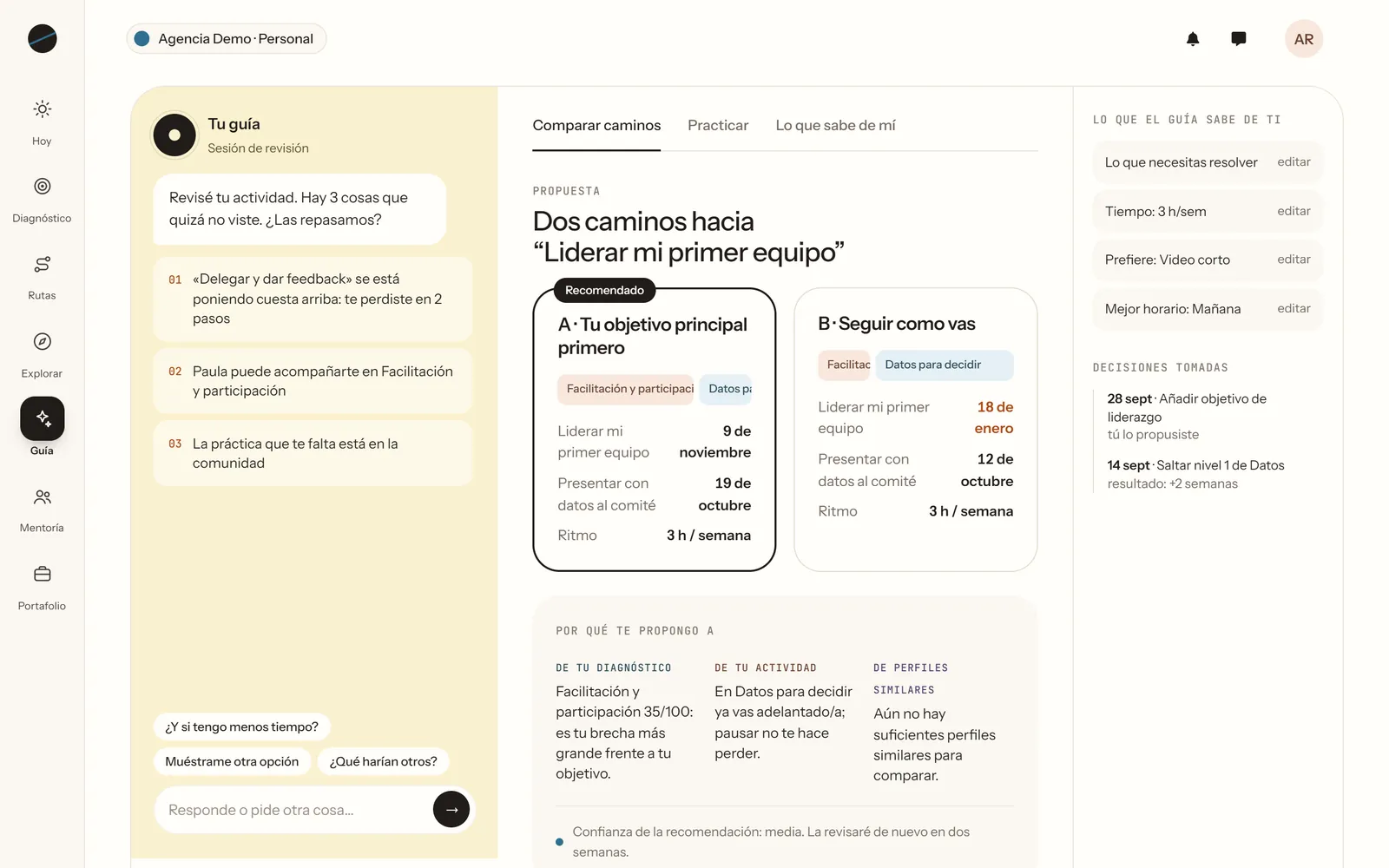
This is deliberate. An artificial intelligence that recommends without explaining is another form of opaque authority, and training already has enough of that. In vetalearn, the guide talks, but the numbers come from a rules engine that can be audited. If the language model isn’t available, the guide keeps working on rules. Nothing it suggests is a black box.
09 — The evidenceWhat remains afterwards
Ana · three weeks later
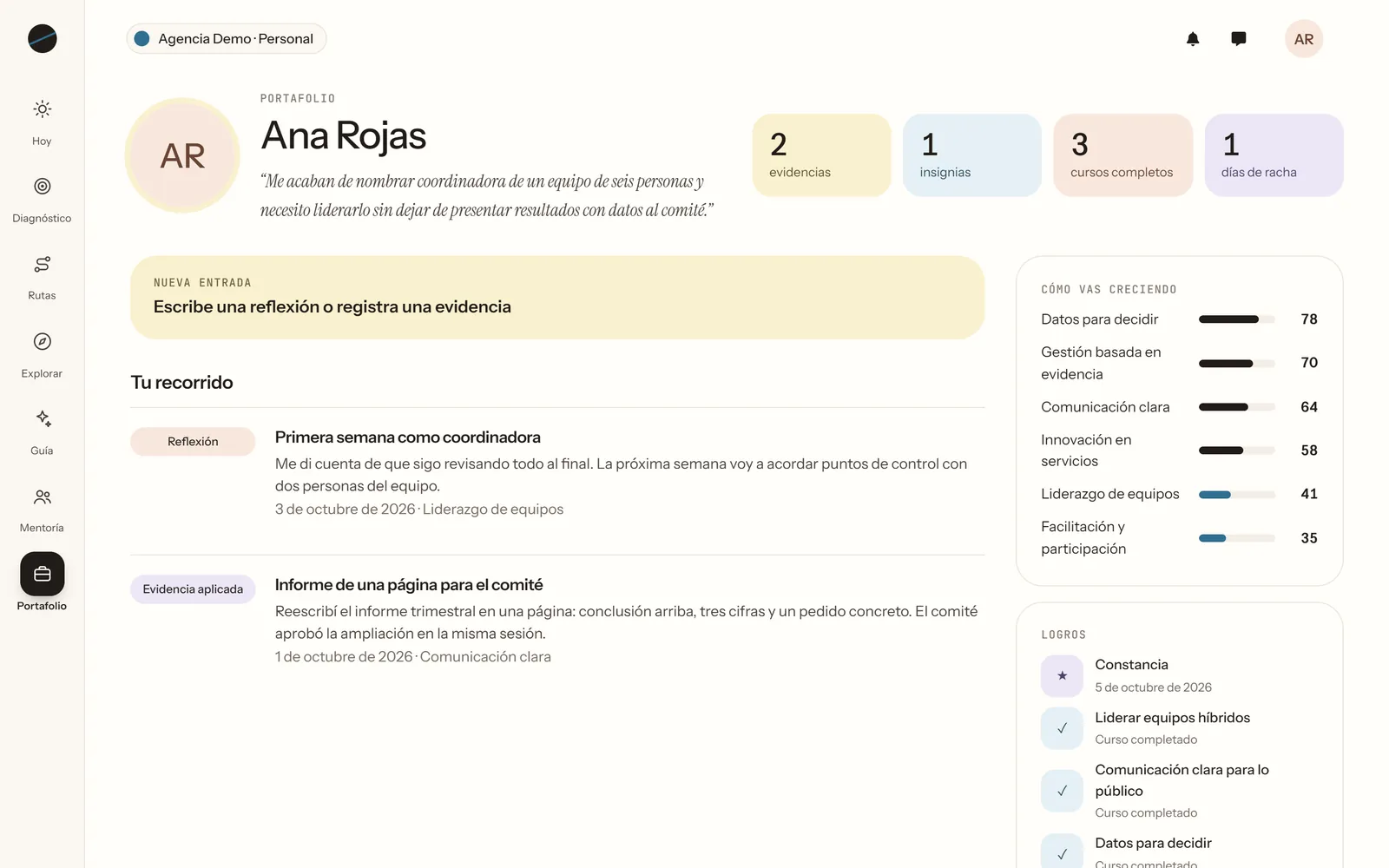
Ana rewrote the quarterly report on one page: the conclusion at the top, three figures, one concrete request. She logged it in her portfolio as applied evidence. She also wrote a reflection that didn’t come easily: she realised she still checks everything at the end, and that next week she will agree checkpoints with two people on the team.
Elena · that same Thursday
Elena was on the committee Ana presented to. One page, three figures, one request. The committee approved the extension in the same session. That afternoon, Camila sends her a link: an aggregate report from the network, no account needed, no names. Goals achieved, applied evidence, growth against the baseline. Elena puts the folder of certificates away in a drawer.
The meeting · Thursday, 4:00 p.m.
Ana runs the participation meeting with what she talked through with Paula: a quick round at the start so that each person says a single sentence, timed turns, and a question asked out loud to whoever hasn’t spoken. The woman at the back, the one who raised her hand twice a month ago, speaks. She says something nobody had said about the health post’s opening hours. At six, the hall is still full.
Nobody in that room knows that what just happened has anything to do with an “I’m lost”.
10 — The mapHow the stories touch
This is how a single signal, Ana’s, flows between the five. None of them had to ask anything of anyone else.
11 — Use casesWhere it fits
- New leaders. Recently promoted people who need results in weeks, not semesters.
- Training for public servants in local-government networks, with their own competency frameworks and questions written from their own reality.
- Cooperation-funded programmes that must show change, not attendance, and need aggregated evidence for the funder.
- Organisations with internal and external audiences: their own staff and their partners, each with their own space, branding and paths.
- Communities of practice and internal mentoring, where the most valuable knowledge isn’t in a course but in someone in the office next door.
12 — HonestlyWhat exists today and what’s missing
I promised not to sell smoke, so this is what there is and what there isn’t.
| Works today | Still missing |
|---|---|
|
|
Films with several interwoven stories have something uncomfortable about them: they make you see that what happens in one life depends on decisions made in others, by people who will never meet. Training works the same way. A button on Ana’s screen ends up in a community hall where, at last, someone who wasn’t speaking speaks.
I don’t know whether vetalearn will achieve everything this piece imagines. I do know the question is the right one. And I know that the next time someone offers you a forty-hour course, it’s worth handing them another question back:
What will I be able to do on Tuesday?
About this story. Ana, Camila, Inés, Elena and the meeting are fictional. The screenshots are real: they come from a vetalearn test environment with demo data.
Further reading. Justin Reich and José A. Ruipérez-Valiente, “The MOOC pivot”, Science (2019). · Hermann Ebbinghaus, Über das Gedächtnis (1885). · Josh Bersin, writing on learning experience platforms (2017 onwards).